Custom LASIK - Individualized Laser Vision Correction
Live your best life with your personal best vision
(The following information was prepared by VISX.)
CustomVue Individualized Laser Vision Correction was developed by VISX, the company recognized world-wide for bringing innovation and breakthrough technology to laser vision correction. With CustomVue, a new standard in laser vision correction is established, providing a precise level of measurement and correction never before possible.
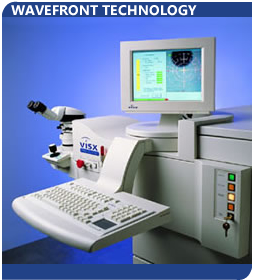
Using WaveScan-based digital technology, originally developed for use in high-powered telescopes to reduce distortions when viewing distant objects in space, doctors can now identify, measure, and correct imperfections in an individual's eyes 25 times more precisely than with standard methods used for glasses and contact lenses. This information is transferred to the laser, providing a new level of precision and accuracy.
Just like a fingerprint, each person's vision is 100% unique to their eyes. Before the recent advancements in technology, doctors were only able to use standard measurements to correct vision, meaning that prescriptions could only provide a certain level of correction regardless of any individual's needs. Now VISX CustomVue can measure and correct the unique imperfections of each individual's vision and provide them with the potential to experience better vision than is possible with glasses or contact lenses - Personal Best Vision.
The laser vision correction process begins with a consultation with your doctor where a patient can learn about the technology and the procedure. An evaluation follows to assess a patient's overall health and to measure and create a detailed and unique map of their eyes. Once it's confirmed that an individual is a good candidate for laser vision correction, the procedure can be scheduled. On the day of the procedure, anesthetic drops are placed into the patient's eyes. The patient's unique correction information is transferred from the WaveScan to the laser. Laser vision correction works by gently reshaping the cornea with the cool beam from the laser to remove microscopic amounts of tissue - less than the thickness of a human hair in most cases - to create a new curvature. The procedure typically takes several seconds and the majority of individuals feel no discomfort. Many patients notice immediate results after CustomVue and vision continues to improve over several days. Routine follow-up visits compete the process.
 One year after the CustomVue procedure, patients in a clinical study reported theses great results without glasses and contact lenses. One year after the CustomVue procedure, patients in a clinical study reported theses great results without glasses and contact lenses.
-
100% could pass a driving test
-
98% could see 20/20 or better
-
70% could see better than 20/20
In a clinical study, four times as many people were very satisfied with their night vision after the procedure as compared to their night vision before with glasses or contact lenses.
VISX lasers have been used to perform millions of laser vision correction procedures in the U.S. and around the world. Are you a candidate? The first step is to call your eye care professional to schedule a doctor's consultation. During the consultation you can review the details of the technology and the procedure and be that much closer to living your best life with your Personal Best Vision!
|